 Offers
 Packs & Gifts
 Featured
 Brands
 Blog
Blog- Out of stock
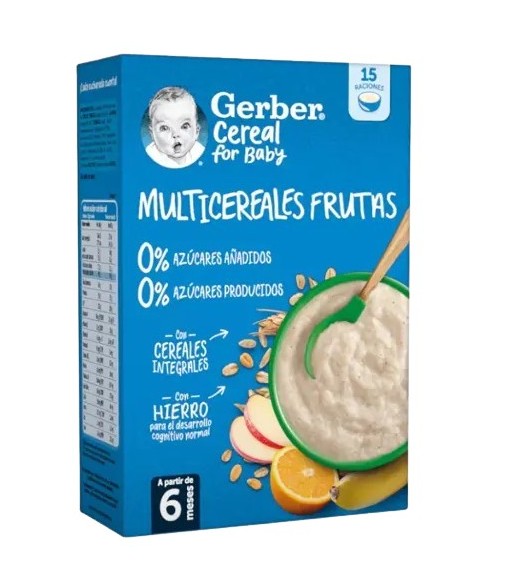



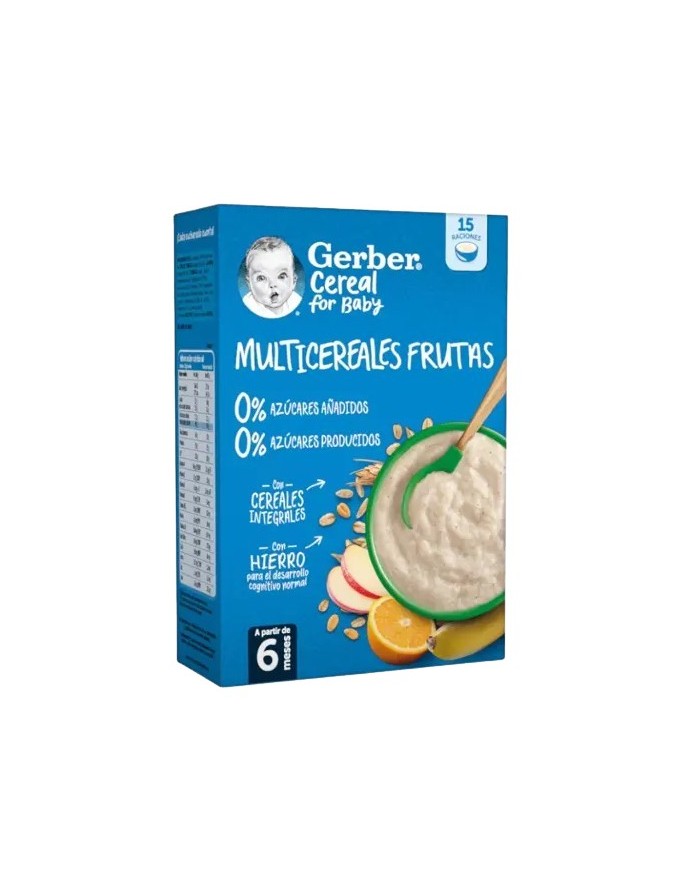
It is a cereal porridge for babies that contains neither added nor produced sugars, because we do not add sugars nor use hydrolyzed or dextrinated cereals.
Gerber baby food contains whole grain baby cereal, which provides the nutritional richness of cereals.
From 6 months.
 5% off in your first purchase! And subsequent purchases are also cheaper with FarmaClub.
 Free samples with orders over 59€!
 Need more units? Can't find what you're looking for? Contact us


Formulation designed for complementary feeding in the world of the baby: mixture of wholemeal flours (wheat, whole wheat, whole oats, barley and corn) combined with dehydrated fruits (banana, apple and orange).
The recipe does not use hydrolyzed or dextrinized cereals, so it contains no added or produced sugars, which helps build healthy eating habits from the first months.
Nutritional profile geared towards the needs of infants from 6 months: energy supply from complex carbohydrates and fiber provided by whole grains, which facilitates a more sustained energy release and contributes to healthier digestion.
Enriched with key micronutrients for growth and development: iron (prevention of iron deficiency anemia), calcium (bone formation), zinc, iodine (metabolic and thyroid function), and a vitamin complex including C, E, B3, B1, A, B6, folic acid and D.
Compatibility with feeding practices: suitable for combination with both breast milk and infant milks and adapted formulas, therefore it is integrated into breastfeeding plans and regimens with infant milks.
The consistency allows for spoon-feeding or bottle-feeding, depending on the baby's preference and ability. It is not a substitute for breast milk or formula in the first few months; its use should be part of the gradual introduction of complementary foods and under professional guidance.
Technological and sensory aspects: use of sunflower lecithin as an emulsifier to improve texture and a natural aroma for oral acceptance.
Formulated with ingredients containing gluten; may contain traces of milk, so it is not suitable for infants with celiac disease or cow's milk protein allergy.
Storage and safety: 270g package, stable under storage conditions in a cool, dry place.
Once opened, it is recommended to consume within 4 weeks and do not use if the packaging is damaged or altered. The product contains added mineral salts and vitamins according to the requirements of the solid food introduction stage.
Relationship with other perinatal care products: geared towards infant feeding; its use is part of the continuum that includes breastfeeding, infant milks and, in the prenatal and postnatal context, consultation on supplements for pregnant women and planning of the baby's feeding.
Automatic translation. It may contain errors.
Farmaten, your Online Pharmacy for health products and cosmetics, sends its products free of charge throughout mainland Spain and also in the Canary Islands (Tenerife, Gran Canaria, Fuerteventura, Lanzarote, El Hierro, La Gomera and La Palma) and the Balearic Islands (Mallorca, Ibiza, Menorca, Cabrera and Formentera).
- No added or produced sugars, it promotes healthy eating habits in children.
- Enriched with iron, calcium, zinc, iodine and vitamins (C, E, B3, B1, A, B6, folic acid and D) for growth support.
- High proportion of whole grains (21.5% whole wheat; 9.2% whole grain oats) that provide fiber and slow-release energy.
- Includes dehydrated fruits (banana, apple, orange) that provide natural flavor and fractions of carbohydrates and micronutrients.
- Versatile in preparation: suitable for spoon or bottle, compatible with breast milk and infant formula.
- Formula without the use of hydrolyzed or dextrinized cereals, avoiding sugars produced during processing.
From what age is it recommended?
Suitable for babies from 6 months as part of complementary feeding. Not intended for infants under 6 months without pediatric supervision.
Can it be mixed with breast milk or infant formula?
Yes. Compatible with breast milk and infant formula; allows you to prepare the porridge with the milk the baby usually uses.
Does it contain added sugars or naturally occurring sugars?
It contains no added or produced sugars, as the formulation does not use hydrolyzed or dextrinized cereals.
Is it suitable for babies with gluten intolerance or celiac disease?
No. It contains gluten and is not suitable for people with celiac disease or gluten intolerance.
Can it cause reactions if there is a milk allergy?
May contain traces of milk; in case of allergy to cow's milk protein, its use is not recommended without medical advice.
How should it be stored and how long does the can last once opened?
Store in a cool, dry place. Consume within 4 weeks of opening. Do not use if the packaging is damaged.
Can it be used in a baby bottle?
Yes. It is formulated to be prepared both with a spoon and with a bottle, respecting the quantity indications and the baby's age.
Does it require any sterilization process or special handling?
It does not require sterilization of the product itself; the utensil (bottle or spoon) should be kept clean and, if applicable, sterilized according to usual practices for infant feeding.
Preparation for eating with a spoon:
1. Pour 160 ml of warm milk (breast milk or formula) into a bowl or plate.
2. Add 17g (approx. 3–4 tablespoons) of the porridge.
3. Stir with a fork until you obtain a homogeneous consistency.
4. Check the temperature before administering.
Bottle preparation:
1. Add to the bottle the amount of milk and porridge indicated by the pediatrician, according to the age and tolerance of the baby.
2. Shake the bottle until a homogeneous mixture is achieved and check the temperature before offering.
Technical recommendations: Adjust the amount of flour to modify the consistency according to the baby's swallowing ability; mix with breast milk or infant formula to adapt the flavor and nutrients. Always follow the pediatrician's instructions and adjust the consistency according to the baby's development.
- Contains gluten; not suitable for celiac disease or gluten intolerance.
- May contain traces of milk; risk for those allergic to milk protein.
- It does not replace breast milk or infant formula during the first months; it is a complementary food.
- Store in a cool, dry place; consume within 4 weeks of opening.
- Do not use if the packaging is damaged or altered.
- Keep out of reach of children.
- Always check the temperature before administering to avoid burns; caution with microwaves due to the generation of "hot spots".
- If you have any questions about intolerances, allergies or the introduction of new foods, consult a healthcare professional.
-Presentation format: 270 g
Cereals 94.6%: wheat flours, whole wheat (21.5%), whole oats (9.2%), barley and corn.
Dried fruits 4.1%: banana (2.7%), apple (0.7%), orange (0.7%).
Emulsifier: sunflower lecithin.
Mineral salts: calcium, iron, zinc, iodine.
Vitamins: C, E, B3, B1, A, B6, folic acid, D.
Natural aroma.
Contains gluten. May contain traces of milk.
Recipe:
Creamy multigrain porridge with pear puree (for babies 6+ months)
Ingredients:
- 160 ml of warm breast milk or infant formula.
- 17g of Multicereal Fruit porridge (approx. 3–4 tablespoons).
- 1-2 tablespoons of natural pear puree (no added sugar).
Preparation:
1. Mix the warm milk with the baby food until you get a smooth texture.
2. Add the pear puree and mix until combined.
3. Adjust the consistency with more or less milk according to the baby's ability.
Benefits: It reinforces the introduction of new textures and flavors, and adds fiber and natural vitamins from the fruit.
Note: Avoid giving honey to children under 12 months.
Diet:
Example of a daily feeding guide for a 6-8 month old baby introducing pureed food:
- Breakfast: Multi-cereal porridge. Fruit prepared with breast milk or infant formula.
- Mid-morning: Breastfeeding or infant formula feeding according to established pattern.
- Meal: Vegetable puree and protein (vegetables + potato + chicken/fish, well pureed).
- Afternoon: Drink milk and/or eat pureed fruit (e.g., apple or pear compote).
- Dinner: Light porridge or vegetable puree according to appetite and tolerance.
Dietary considerations: the amounts and frequency depend on the pattern of breastfeeding or use of infant formula; the porridge can serve as breakfast or dinner to introduce whole grains and fruit.
Personalize according to the pediatrician's recommendations and the baby's progress in the complementary feeding process.
It is a cereal porridge for babies that contains neither added nor produced sugars, because we do not add sugars nor use hydrolyzed or dextrinated cereals.
Gerber baby food contains whole grain baby cereal, which provides the nutritional richness of cereals.
From 6 months.