 Offers
 Packs & Gifts
 Featured
 Brands
 Blog
BlogRegarding medicines and products
Yes, but the online sale of medications is subject to specific regulations and, where applicable, is only carried out in the Canary Islands (Spain) with pharmaceutical supervision.
Only non-prescription medications are sold online.
Yes, medication is always dispensed under the supervision of a licensed pharmacist. In addition, you can receive personalized pharmaceutical advice if you wish.
No, regulations only allow the online sale of non-prescription medications. If you need to purchase any other medication, we'd be happy to assist you in person at our pharmacy.
Yes, but only non-prescription medications listed in the Medications section of our website. If you need to purchase any other medication, we'd be happy to assist you in person at our pharmacy.
No, due to current regulations, it is not possible to offer any discounts or incentives on medication purchases.
Yes, cannabidiol (CBD) oil is generally considered safe and well-tolerated, according to the World Health Organization (WHO). CBD oil is legal in Spain as long as it is extracted from hemp and has less than 0.2% THC content, meaning it does not contain significant amounts of this psychoactive compound.
At Farmaten, you can find a small selection of THC-free CBD products for topical use.
SPF (Sun Protection Factor) is a measure that indicates how much longer your skin can withstand ultraviolet B (UVB) radiation, the kind that causes sunburn, compared to not using sunscreen. A higher number (like SPF 30 or 50) means it blocks a greater percentage of UVB rays and protects you for a longer period, although it's always crucial to reapply every few hours to maintain effectiveness.
To choose the right SPF, you should consider your skin type and the UV index of the area you'll be exposed to.
Sun protection not only prevents sunburn and redness but also reduces the risk of premature aging and skin cancer (UV radiation damages skin cells).
The most suitable level of protection depends on the ultraviolet index, geographic location, season, and your skin type.
We can group them as follows:
- Low protection: SPF 6 to 14.
- Medium protection: SPF 15 to 29.
- High protection: SPF 30 to 50.
- Very high protection: SPF 50+.
The higher the ultraviolet radiation index, the higher the level of protection. Lighter skin tones require a higher level of protection than darker skin tones. In general, the more you are exposed to sunlight, either in intensity or duration, the more protection you will need (for example, in summer, in mountainous areas, at the beach, in tropical regions, etc.).
SPF isn't the only important factor:
- Apply sunscreen at least 20 minutes before sun exposure.
- Reapply sunscreen every two hours and after swimming in a pool or at the beach.
- Broad-spectrum sunscreens protect against both UVA and UVB radiation and include other beneficial ingredients.
- Different product formulations, offering the same level of protection, may vary in ease of application, texture, water resistance, etc.
Yes, you should check the packaging. According to European regulations, you can find two types of indications:
- Expiration date. On the packaging of some products, you will see the text "Exp" or "Cad," an expiration date expressed in month and year (usually indicated next to an hourglass symbol). This date indicates the total shelf life of the unopened product. It usually appears on products whose stability does not exceed 30 months, because their ingredients lose effectiveness or decompose over time, or because the product does not contain preservatives and is therefore more susceptible to microorganisms. It is not recommended to use the product after the expiration date.
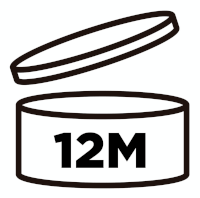 Shelf life. On the packaging of most creams and makeup, you will see a symbol of an open jar with a number and an "M." This is called the PAO symbol (Period After Opening) and indicates how many months the product has a shelf life once opened. For example, if you see "6M," it means that six months after opening, the product will have deteriorated significantly due to exposure to air, light, and microorganisms. It may change in texture or smell, or its effectiveness may decrease. It is recommended to write the date of first opening on the packaging.
A product can have both indicators. For example, a product may have a broad expiration date of one or two years (the product is stable when the container is sealed) and also have a PAO (Period After Opening) of six months, since it begins to deteriorate after first opening.
In any case, you should store the containers properly, in cool, dry places: expiration and PAO dates apply to products stored correctly. If you notice that the product's texture or smell has changed significantly, whether it is expired or not, it is best to discard it.